
Hi friends!
I organized another series of leadership roundtables through Game Dev MTL this past summer, and wanted to share the notes here. This is article 1/3, others will be posted soon! I learned a lot from the session, hopefully these notes will help you learn too!
Leadership vs Management?
Pretty quickly after the round-table started, it was brought to my attention that what I wrote as “leadership styles” might actually be management styles, according to two folks who studied management who were in the roundtable. We discussed the differences:
- Leadership: how you influence people, how you inspire people to do the things you / the company needs
- Management: the logistical aspects of running a team, how things get done
Of course there’s a lot of overlap, and a lot of folks who run (especially small) studios are leaders and managers. But the best leaders are not always managers, and the best managers are not always leaders.
The most common leadership styles were talked about through a variety of personality tests and leadership tests which are discussed in the sections below and the resources sections.
Leadership Styles
To read about all of the leadership styles discussed and their descriptions, see the appendix section below. Note that none of these leadership styles are “good” or “bad”, and we dismissed any styles which were outright negative. For example, “autocratic” is usually seen as dictatorial and therefore negative, but calling this style “commanding” (and with the definition given on the Miro board) this has a different connotation. As mentioned, these might be more management styles than leadership styles, a distinction I didn’t make before the session.
Some notes on adapting your leadership style:
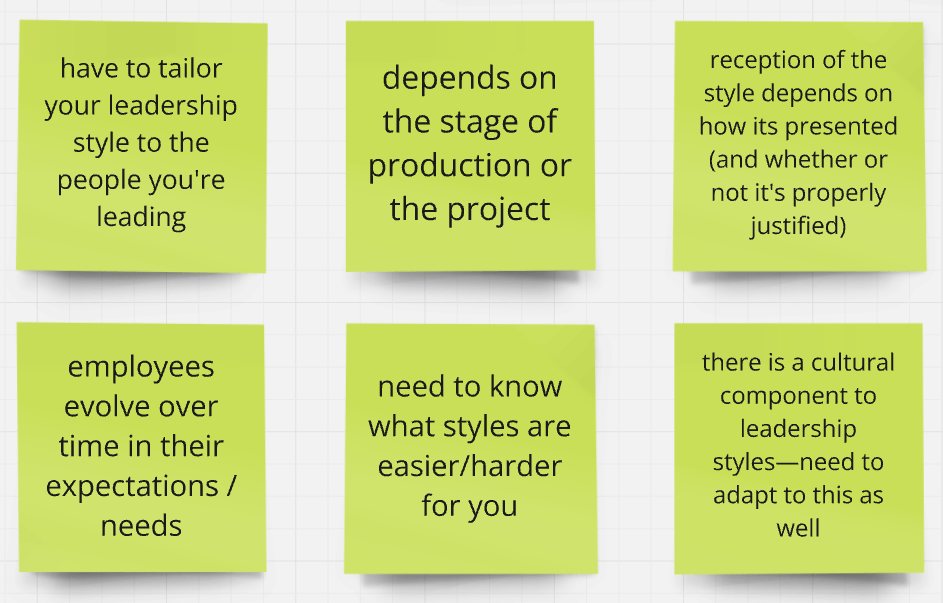
Setting Expectations about your Leadership/Management Style
We talked about how you communicate your leadership/management style to your team, and when this takes place.

Personality Tests
We talked about personality tests when discussing the different leadership styles, see the resources section for links.

Other Important Notes
We discussed leadership in general and some of our struggles and successes. Some common themes came up, especially around setting boundaries for what a leader or manager should be responsible for—it’s important to be empathetic, respect your employees and give them every chance to succeed while accommodating them as much as possible. But at the same time they need to be doing their work and you’re not responsible for being their therapist or their friend.

Hope this was helpful! Give me a follow on BlueSky or LinkedIn to see more posts like this and other game dev leadership stuff!
Resources & Further Reading
- Leadership personalities and colours (many sites talk about this, but this one seemed simple and clear)
- MBTI personality types from 16personalities — includes a free test and LOTS of explanation
- The Four Tendencies — book by Gretchen Rubin
- Enneagram tests — information and a free test
- Dare to Lead — podcast (and book) by the amazing Brene Brown
Appendix — Leadership Styles Discussed
Here are the leadership styles shared before the talk:
👑 Commanding / Autocratic
- Description:
- The leader makes sets clear goals and objectives that they expect others to follow.
- Application:
- Useful in crisis situations where quick decisions are needed.
- May be effective with small teams or during critical phases of development
- Risk of stifling creativity and reducing team morale if overused.
🙋♀️ Democratic / Participative
- Description:
- Decisions are made based on team input and consensus.
- Application:
- Encourages team involvement and fosters creativity, essential for game design and development.
- Effective for medium to large teams where diverse ideas can enhance the project.
- Can be time-consuming, potentially slowing down decision-making.
🧛♀️ Delegative / Laissez-Faire
- Description:
- Leaders provide minimal supervision and allow team members to make decisions.
- Application:
- Works well with highly skilled and experienced teams who require little oversight.
- Encourages innovation and personal responsibility, often leading to creative game development.
- Risks include lack of direction and potential for underperformance if team members are not self-motivated.
💁♂️ Servant
- Description:
- Leaders prioritize the needs of the team and focus on their development and well-being.
- Application:
- Fosters a supportive and collaborative environment, essential for team cohesion.
- Promotes trust and respect, leading to high team morale and loyalty.
- Can be challenging to balance with the need for decisive leadership in fast-paced game development environments.
🤝 Transactional
- Description:
- Focuses on the role of supervision, organization, and group performance; rewards and punishments are used to motivate.
- Application:
- Suitable for meeting deadlines and achieving specific project goals.
- Can be effective in large teams where structure and clear objectives are necessary.
- May limit creativity if not balanced with opportunities for innovation.
🏗 Transformational (Similar to Coaching)
- Description:
- Leaders inspire and motivate team members to exceed their own self-interests for the good of the team and project.
- Application:
- Ideal for inspiring creativity and innovation, crucial in the gaming industry.
- Can help build a strong company culture and high levels of team engagement.
- Requires leaders to be charismatic and supportive, which might be challenging for some.
🤼 Affiliative (Relational)
- Description:
- Relationship-focused style with an aim of creating harmony on the team.
- Application:
- Creating new teams.
- Working in situations that require a lot of trust.
- Can create emotional dependence on the leader.
- Can bring about unclear goals or roles, leading to less efficiency.
👩🎤 Visionary (Similar to Pace-Setting)
- Description:
- Leaders articulate a clear vision and direction, inspiring and guiding the team towards long-term goals.
- Application:
- Essential for setting a compelling direction for game development projects.
- Motivates teams by providing a sense of purpose and alignment with company goals.
- Needs strong communication skills to ensure the vision is effectively conveyed and embraced.
 Richard's Blog