Leadership Styles and How to Put Them into Practice [Roundtable Notes]

Hi friends!

I organized another series of leadership roundtables through Game Dev MTL this past summer, and wanted to share the notes here. This is article 1/3, others will be posted soon! I learned a lot from the session, hopefully these notes will help you learn too!


Leadership vs Management?

Pretty quickly after the round-table started, it was brought to my attention that what I wrote as “leadership styles” might actually be management styles, according to two folks who studied management who were in the roundtable. We discussed the differences:

  • Leadership: how you influence people, how you inspire people to do the things you / the company needs
  • Management: the logistical aspects of running a team, how things get done

Of course there’s a lot of overlap, and a lot of folks who run (especially small) studios are leaders and managers. But the best leaders are not always managers, and the best managers are not always leaders.

The most common leadership styles were talked about through a variety of personality tests and leadership tests which are discussed in the sections below and the resources sections.


Leadership Styles

To read about all of the leadership styles discussed and their descriptions, see the appendix section below. Note that none of these leadership styles are “good” or “bad”, and we dismissed any styles which were outright negative. For example, “autocratic” is usually seen as dictatorial and therefore negative, but calling this style “commanding” (and with the definition given on the Miro board) this has a different connotation. As mentioned, these might be more management styles than leadership styles, a distinction I didn’t make before the session.

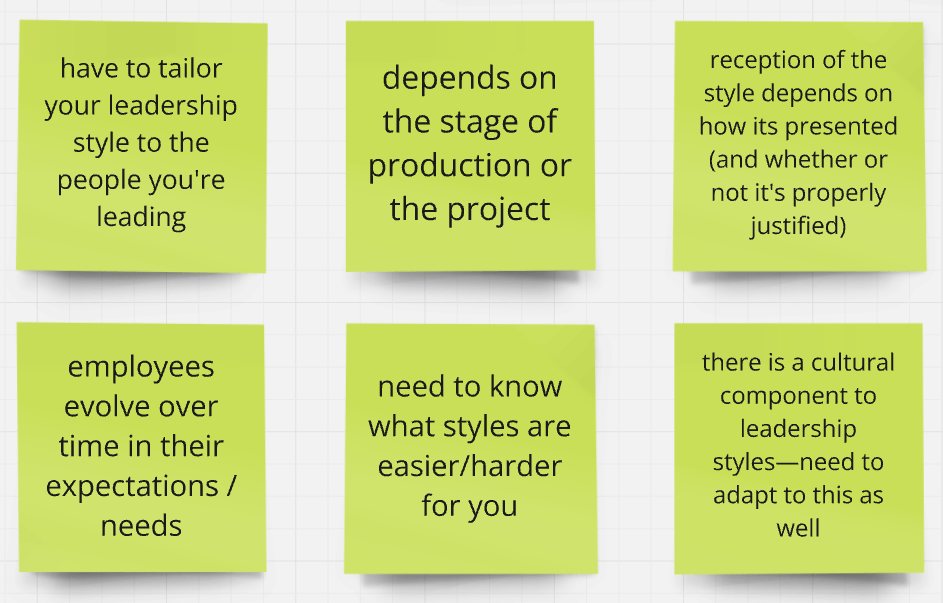
Some notes on adapting your leadership style:

Setting Expectations about your Leadership/Management Style

We talked about how you communicate your leadership/management style to your team, and when this takes place.


Personality Tests

We talked about personality tests when discussing the different leadership styles, see the resources section for links.


Other Important Notes

We discussed leadership in general and some of our struggles and successes. Some common themes came up, especially around setting boundaries for what a leader or manager should be responsible forโ€”it’s important to be empathetic, respect your employees and give them every chance to succeed while accommodating them as much as possible. But at the same time they need to be doing their work and you’re not responsible for being their therapist or their friend.

Hope this was helpful! Give me a follow on BlueSky or LinkedIn to see more posts like this and other game dev leadership stuff!


Resources & Further Reading

Appendix โ€” Leadership Styles Discussed

Here are the leadership styles shared before the talk:

๐Ÿ‘‘ Commanding / Autocratic

  • Description:
    • The leader makes sets clear goals and objectives that they expect others to follow.
  • Application:
    • Useful in crisis situations where quick decisions are needed.
    • May be effective with small teams or during critical phases of development
    • Risk of stifling creativity and reducing team morale if overused.

๐Ÿ™‹โ€โ™€๏ธ Democratic / Participative

  • Description:
    • Decisions are made based on team input and consensus.
  • Application:
    • Encourages team involvement and fosters creativity, essential for game design and development.
    • Effective for medium to large teams where diverse ideas can enhance the project.
    • Can be time-consuming, potentially slowing down decision-making.

๐Ÿง›โ€โ™€๏ธ Delegative / Laissez-Faire

  • Description:
    • Leaders provide minimal supervision and allow team members to make decisions.
  • Application:
    • Works well with highly skilled and experienced teams who require little oversight.
    • Encourages innovation and personal responsibility, often leading to creative game development.
    • Risks include lack of direction and potential for underperformance if team members are not self-motivated.

๐Ÿ’โ€โ™‚๏ธ Servant

  • Description:
    • Leaders prioritize the needs of the team and focus on their development and well-being.
  • Application:
    • Fosters a supportive and collaborative environment, essential for team cohesion.
    • Promotes trust and respect, leading to high team morale and loyalty.
    • Can be challenging to balance with the need for decisive leadership in fast-paced game development environments.

๐Ÿค Transactional

  • Description:
    • Focuses on the role of supervision, organization, and group performance; rewards and punishments are used to motivate.
  • Application:
    • Suitable for meeting deadlines and achieving specific project goals.
    • Can be effective in large teams where structure and clear objectives are necessary.
    • May limit creativity if not balanced with opportunities for innovation.

๐Ÿ— Transformational (Similar to Coaching)

  • Description:
    • Leaders inspire and motivate team members to exceed their own self-interests for the good of the team and project.
  • Application:
    • Ideal for inspiring creativity and innovation, crucial in the gaming industry.
    • Can help build a strong company culture and high levels of team engagement.
    • Requires leaders to be charismatic and supportive, which might be challenging for some.

๐Ÿคผ Affiliative (Relational)

  • Description:
    • Relationship-focused style with an aim of creating harmony on the team.
  • Application:
    • Creating new teams.
    • Working in situations that require a lot of trust.
    • Can create emotional dependence on the leader.
    • Can bring about unclear goals or roles, leading to less efficiency.

๐Ÿ‘ฉโ€๐ŸŽค Visionary (Similar to Pace-Setting)

  • Description:
    • Leaders articulate a clear vision and direction, inspiring and guiding the team towards long-term goals.
  • Application:
    • Essential for setting a compelling direction for game development projects.
    • Motivates teams by providing a sense of purpose and alignment with company goals.
    • Needs strong communication skills to ensure the vision is effectively conveyed and embraced.

How to Interact With Us: Onboarding Tool to Facilitate Communication

Team communication issues often come from differences in how people communicate and how people want to be communicated with. This can be cultural, personal preference, or forged by previous work experience. Either way, every team member has specific ways that they like to interact, receive feedback, and collaborate on tasks.

When discussing our approach to communication at Clever Endeavour Games, other leaders often ask for details, so I thought I’d share that here.

What we do at Clever Endeavor is that we have a form called How to Interact With Us that all employees fill in at the beginning of their employment. When a new employee joins, everybody on the team updates their own How to Interact With Us page and also reads everyone else’s page. This is not only for managers! It’s important that anyone who will be working together understands the quirks of their colleagues, and it helps to accelerate this process to avoid miscommunication and frustrations.

Even when we don’t have new employees, we do this once a year anyway, because things change from year to year in terms of how people want to be interacted with. The form includes these questions:

  • Conditions I like to work In
  • The times / hours I like to work
  • The best ways to communicate with me
  • The ways I like to receive feedback
  • Things I need
  • Things I struggle with
  • Things I love
  • Other things to know about me

I’ll give a couple of examples of my own answers:

Best ways to communicate with me: “Ping me on Discord. Ideally, ping me in an open channel so that people see the conversations we’re having so that it promotes more of a culture of constant communication.”

Things I struggle with: “The balance between micro-managing and not giving enough direction. I donโ€™t want to have my hands in everyoneโ€™s work but also want to make sure everyoneโ€™s working toward the same goal and has motivation in their work.”

From one of my employeesโ€”The hours I like to work: “It depends on the day. Lately Iโ€™ve been working late mornings – late evening, but I am sometimes up early mornings to afternoon.”

Some of these are somewhat “easy”โ€”enjoying working early in the morning, preferring focused time in the afternoon, whether they like to get feedback in open channels or direct messages, etc. But I’ve also had examples in the past where someone has said that they can sometimes get distracted on video calls because of their ADHD and therefore I shouldn’t feel bad to call their attention to the discussion if I see them drifting. Had I not known that, I might have assumed that their wandering attention was because they were bored, not checked in, or not motivated.

In general, it’s important to communicate differently with each person on the team whether you’re a manager any other team member, and tools like this can help you encourage effective communication. Highly recommend!

โค
Rich

Hiring & Onboarding – [Notes from 2023 Roundtables 3/3]

Hey folks!

Anoter leadership roundtable organized through Game Dev MTL discussed hiring and onboarding. Here are the notes that were shared with the rest of the roundtable (shared publicly with their permission).

Note that some information here may be missing the context of the in-person conversation, but I still think they can be helpful.

Roundtable 1/3: Designing & Maintaining Company Culture
Roundtable 2/3: Feedback, Reviews & 1 on 1s
Roundtable 3/3: Hiring and Onboarding

Sorting Through Applicants

Different folks at the roundtable had different ways of sorting through applicants.

There were a number of tips that came up during the roundtable, which Iโ€™ll share below:

There were a couple of additional points that came up that were worth discussing:

  • โ€˜even if not hired, applicants evolve over many years and can be a good fit in the futureโ€™ โ€” be sure to respond to applicants and keep contact with them in the future. Also, an important note (that weโ€™ll get to later in this email) about not keeping their information around for over a year because of the new Bill 25.
  • โ€˜leads might try to reject some applicants if they’re worried about their own positionโ€™ โ€” a couple of folks brought this up, where theyโ€™ve had people dismiss what would otherwise be good applications because of their concern for their position (consciously or not!). Itโ€™s important then, as mentioned above, to make it very clear what the criteria is and make sure that enough people are reviewing applications to make sure that this gets caught if it happens.

Lastly, where do you post your jobs?

Added noteโ€”in another roundtable in 2024 someone talked about places to post jobs to seek out more diversity (especially useful in Quebec or Canada):

Interviews

Everyone in the group did interviews or interview-like conversations. Usually there was a vibe check or a phone call with filtering questions, followed by a formal interview with the hiring manager and the leads of the department or the people who would be responsible for managing the employee.

Some notes about the process and especially about tests. Note that this was a small group and doesn’t reflect the whole industry, even in Montrealโ€”some folks in the industry are strongly against testing during the hiring process (but those people weren’t vocal in these roundtables).

Hiring Logistics

We then moved to any sorts of tips and tricks people might have regarding the actual logistics of hiringโ€”contracts, hardware, etc.

We talked about the importance of being well organized with a list of:

  • all of the steps that take place before the person is hired (for the hiring manager)
  • what we need from the new employee before they start: void cheque, information for payroll, required hardware, etc.
  • employee guide which includes policies, values, processes, etc.

This content started bleeding into onboarding pretty quickly so we jumped right over to that.

Onboarding

Onboarding was the bulk of the discussion, since onboarding is so so so important. We had lots of notes that I tried to organize into categories, so hopefully they make sense to you too.

Lastly, we got into discussion about legal requirements around hiring and HR processes. There was a lot to talk about here, but there was one point about what employees are legally required to sign. See the resources section piece about Law 25. As one participant said, โ€œmieux prรฉvenir que guรฉrir!โ€ (better to prevent than to healtry to fix the problem after).

And one big sticky note which summarized a lot about issues folks had in the past about not having enough processes:

Other Miscellaneous Notes

Because you canโ€™t always categorize everything! Note some of the legal points relate to Quebec, Canada specifically.

Resources

  • Quebec Law 25 obligations
  • Extremely comprehensive list of policies required by a company in Quebec โ€” Iโ€™m not a lawyer but I believe that several of these are covered by default by Quebecโ€™s labour laws, so even if you donโ€™t have a policy around some things the default is whatโ€™s written in the Quebec code. But, Iโ€™m not a lawyer! This isnโ€™t legal advice.
  • Collage HR โ€” tool which helps with gathering and sorting job applications, team members sharing and commenting on them, sending out responses, and can also handle stuff like onboarding, reviews, etc. etc.
  • BitWarden โ€” password manager and secure file sharing (also LastPass but theyโ€™re more expensive and there have been more breaches)
  • http://WorkWithIndies.com โ€” job posting for Indie jobs
  • I was asked to share Clever Endeavour’s “How to Interact With Us” questions โ€” each employee fills this out and every other employee reads theirs to know more about them and how to work with them:
    • Conditions I like to work in
    • The times / hours I like to work
    • The best ways to communicate with me
    • The ways I like to receive feedback
    • Things I need
    • Things I struggle with
    • Things I love
    • Other things to know about me

Hope this was useful to you, I definitely learned a lot from the sessions!

โค
Rich

Feedback, Reviews & 1:1s – [Notes from 2023 Roundtables 2/3]

Hi friends!

The next set of leadership roundtables organized through Game Dev MTL discussed feedback, reviews and 1 on 1 meetings. Here are the notes that were shared with the rest of the roundtable (shared publicly with their permission).

Note that some information here may be missing the context of the in-person conversation, but I still think they can be helpful.

Roundtable 1/3: Designing & Maintaining Company Culture
Roundtable 2/3: Feedback, Reviews & 1 on 1s
Roundtable 3/3: Hiring and Onboarding

Feedback

We started off talking about why we give feedback in the first place, and some interesting points came up:

Also, this very important point:

The way people like to give and receive feedback, its frequency, etc. is all very cultural. This is important to keep in mind especially working with employees or partners in different countries, speaking different languages, etc.

Then we got to how we give feedback, and other things related to how feedback can be received. It’s important to note that there’s a difference between small pieces of feedback, which are small adjustments to modify behaviour, and important “we need to talk” issues.

A couple of the sticky notes above needed some elaboration:

โญ – “need to be explicit about expectations” – this came up in the context of giving someone feedback without it being clear what the expectations were in the first place. If you tell an artist that you want a first pass done of a character, and they present something, and your feedback is that it’s not polished enough or doesn’t look representative of the art in the final game, then this kills your feedback and credibility to give feedback! They’ll learn from this that you’ll criticize their work regardless of what they do, since you’re not being clear about what you want in the first place. Also, getting negative feedback on something that was missing clarity can cause confidence issues (especially in juniors).

โญโญ – “feedback for validation โ†’ can cause issues” – if folks need positive feedback to validate everything they do, this can be a problem because:

  1. they’re less likely to do something imaginative and out-of-the-box because they depend on that validation and it’s less likely to happen if there’s negative feedback, which will happen if they take creative risks with their work
  2. it will scare us (managers) into not ever wanting to give them negative feedback because we know it’s tied to their personality / self-esteem
  3. this is generally a bigger problem which could mean the person isn’t receiving any positive validation from their social / familial ecosystem, and is dependent on you (the manager) in an unprofessional way (i.e. more as a parent/child relationship and not a boss/employee one)

๐Ÿ”Ž – The feedback model from Manager Tools (linked in the resources below) goes something like this. “When you _, here’s what happens. How can you do this differently?” This applies to things like folks showing up late to meetings, work product being sub-par, folks not paying attention in meetings, etc.

1:1 Meetings

We started defining one-on-one meetings, but it’s clear (throughout all of management in all fields of work) that 1:1s are different for different people. Some notes came up:

Some folks at the roundtable had set questions which they asked every time, others had a more free-form meeting. Some question ideas include:

  • any problems?
  • any positive highlights?
  • how is the sprint going?
  • any roadblocks?
  • how is X (task, project) going working with Y (person)?

One of the participants shared their review structure which ties into 1:1s, and which many others found inspiring due to the fact that it tied 1:1s back to evaluations and back to company culture:

Performance Reviews

There were a number of different points raised about performance reviews, including their frequency (most did annual, one person did every 6 months), how people do self-evaluation, etc.:

We talked about 360 reviews, where some number of people who work with the employee review them, and that data is often used to help create annual reviews.

Other Misc Notes

A lot of stuff came up in the chat! Here are some sticky notes:

Resources & Future Questions

And a bonus question which we didn’t have time to dig into enough: “how do you give feedback to someone who is simply working too slowly?” We discussed it a bit, and there were questions around workload, how well they’re being managed, etc… but we didn’t reach a solution!

Hope this was useful to you, I definitely learned a lot from the sessions!

โค
Rich

Designing & Maintaining Company Culture – [Notes from 2023 Roundtables 1/3]

Hey y’all! I organized and led a series of leadership roundtables through Game Dev MTL, and wanted to share the notes here that were shared with the rest of the roundtable (with their permission).

This is part of a series of posts from the various roundtables, and the information on these sticky notes of course are missing the context of the in-person conversation. But I think they can still be very helpful!

Roundtable 1/3: Designing & Maintaining Company Culture
Roundtable 2/3: Feedback, Reviews & 1 on 1s
Roundtable 3/3: Hiring and Onboarding

Defining Culture

The roundtable was introduced and someone brought up the idea that we should probably define culture before we start talking about our biggest successes and biggest mistakes in desigining and maintaining a company culture.

Folks put forward some different ideas that came up when we talk about what culture is and means:

Some folks brought up other, less straightforward ideas around defining culture:

Successes & Mistakes

Then, everyone talked about their greatest success in this regard, and their biggest mistake followed by what they learned from that.

Some of the things people pointed to as biggest successes were either process-related, culture design related, or positive effects of what they felt was a good company culture:

Some of the biggest mistakes people made and the lessons they learned are below. For almost all of the lessons, most of the room nodded their heads in agreement:

Open Discussion

We then moved to open discussion and bounced around a variety of topics. I jotted down some notes during the roundtable and added some more context to them while creating these notes.

  • Trust is huge for culture. Iโ€™ll borrow from Carolina Mastretta from Original Fire Games: โ€œTrust is an emergent part of culture in a team, an ebb and flow that shifts as teams and individual members tackle new challenges, work with new people and face changes, wins and failures. With principles & practices, it can be built, sustained and nourished!โ€ (check out her micro-talk from GDC 2023 if you have access to the Vault)
  • Itโ€™s important to recognize that folks who are not from the same country, background, level of professional experience or language may have very different base cultural assumptions around communication or professional conduct. These implicit, undefined norms will always exist but itโ€™s important to take care to be aware of them and make them explicit.
    • Consider the language you use, inclusive language includes awareness of people who are speaking in their second language, from different cultures, etc.
    • Consider how much of your culture is assumed (which falls prey to these issues of cultural norm) versus how much of the culture is explicitly defined.
  • Meeting culture is a thing! Different companies have different ways of handling agendas, pre-sent materials, open discussion, going off-topic in meetings, timeboxing meetings, etc. This can be exacerbated when working across cultures and native languages.
  • Different countries, industries, and locations (i.e. the Montreal office and the Shanghai office) often have different company culture expectations.
  • If a company actually lives according to its values, then it should be able to check its major and minor decisions against those agreed upon values. For example, whether or not to accept working on a particular project might be informed by the teamโ€™s values.
  • Itโ€™s important to keep team values on the forefront. Most folks agreed that most values and mission documents are created and then stored somewhere, without employees looking at them or even knowing that they are explicitly. People have different strategies for awareness around these values, for example one person said they would randomly throw out a cultural value in morning standup and this got conversation started, sometimes around that value. This got people thinking and talking about company values in a more free-flowing way.
  • Culture is important for retention and attracting talent, as a way of differentiating your team from other teams / organizations. This is especially important given that many of us compete with companies like Epic who can pay massive salaries compared to most smaller or mid-sized studios.
  • Rules around communication are part of company culture.
  • Sometimes someone on the team can start to stray far from the culture / rules of the studio, and this often results in the person leaving or needing to be let go.
  • While a teamโ€™s culture will change with every new addition to the team, itโ€™s also important not to let a new person bulldoze the culture and bend it to their will. Thereโ€™s a give and take element where the new addition needs to be willing to learn and adapt, but also needs the space to be themselves and bring their experience in to help shape the team culture.
  • There needs to be a balance of how broad values are versus how directly actionable they are. Broad values can be vague and easy to either forget about or misinterpret, but values that are too specific might be restrictive or easy to dismiss as being not applicable to the current situation.
  • Sub-teams within a larger organization will interpret values / culture differently, hence why the balance of broad vs specific needs to be kept in mind.
  • People sometimes will stay in a company without fitting the culture because the other things make it worthwhile, for example pay, a 4-day work week, etc. This is known as the โ€œgolden cageโ€ problem. This can be extremely detrimental to company culture because people are checked out but still influencing the culture without buying into or believing in it.
  • The new generation (Gen Z ish) has different values, and this can be a sore spot for managing culture. We talked a bit about the positive and negative aspects of this culture โ€œclashโ€, and what we (most of the folks in the workshop were 30+) can learn from the younger generation.
  • Where does โ€œhard workโ€ fit into culture? It feels sometimes like this canโ€™t be spoken about in a workplace culture because it goes directly against โ€œpeople firstโ€ approaches. This is difficult to manage!
    • Creating estimates together and tracking sprints closely helps with the “hard work” being rewarded, one person said in response
  • Transparency has impact on cultureโ€”financial transparency, the HR process, comapny goals, etc. The default assumption is often that more transparent is better, but some folks mentioned how employees asked for transparency but then werenโ€™t prepared to deal with the feelings that came up when they received that information. This isnโ€™t to say not to be transparent with any of the things above, simply that there is an effect of being either more or less transparent that needs to be considered.

Further Thinking Required

A lot of questions came up during the roundtable, and we could have talked for another 5 hours. So Iโ€™ll leave you with some questions to reflect on:

  • If values are not sufficient to define the whole company culture, then what else is required?
  • How does your company culture show up in your day-to-day work? Meetings, reviews, town hall meetings, communication between team members, etc.
  • How do you integrate young people / the new generation into your culture, or how is your culture changing to incorporate the younger generation and their value set?
  • How much do you transform employees to fit your culture? What is too much (restricting their ability to positively affect your culture) and what is too little (letting them keep the exact same culture from their last workplace and transforming your culture)?
  • When do you start talking about company culture to new employees?

Hope this was useful to you, I definitely learned a lot from the sessions!

โค
Rich